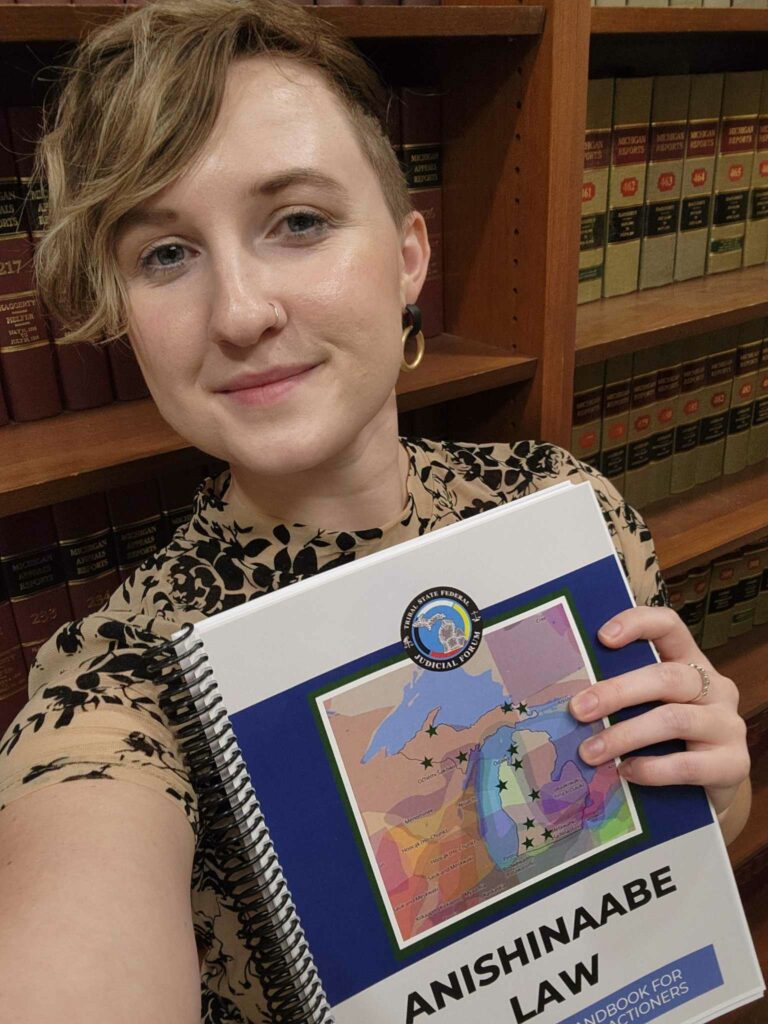
 After several years working with the Tribal State Federal Judicial Forum in Michigan, Judge Allie Greenleaf-Maldonado (Little Traverse Bay Bands of Odawa Indians), and Justice Megan Cavanagh of the Michigan Supreme Court, I am delighted to announce the release of the Anishinaabe Law: A Tribal Law Handbook for Michigan Legal Practitioners.
Here is a link to the official release webpage, including a link to access the book: https://www.courts.michigan.gov/news-releases/2024/november/new-handbook-introduces-tribal-law-to-michigan-law-students/
Here also is a link to hear Justice Cavanagh and I discuss the handbook on Michigan Public Radio: https://www.michiganpublic.org/podcast/stateside/2024-11-22/stateside-podcast-tribal-law-handbook-expands-legal-education
The Story Behind The Book:
As a dual degree JD/PhD student who just graduated from Michigan State University (MSU) College of Law, I witnessed most of my colleagues complete three years of legal education without any exposure to laws from the twelve federally recognized Tribes in Michigan. These Tribes are sovereign entities with their own governments and legal precedent distinct from state and federal laws. Despite the fact that MSU College of Law is a national leader in Indigenous law and policy education, students must choose to learn more about Indigenous law, especially local Tribal laws. The problem with an opt-in approach is that students must already be aware of Tribal governments to know that there are bodies of law about which they can learn. Research demonstrates that an opt-in approach is not viable for diversity, equity,
inclusion, and belonging goals. Since there is seldom reference to Indigenous communities in the first-year standard law school curriculum, the chances of law students becoming aware of Tribal law are low. Furthermore, students attending other Michigan based law schools that do not have established Indigenous law programs have lower chances of exposure. This is a problem because Michigan legal practitioners are almost guaranteed to interact with a Tribe at some point in their careers. Without adequate awareness and preparation, untrained attorneys, judges, prosecutors, and other practitioners can delay proper proceedings, render incorrect judgements or arguments, and ultimately, perpetuate an unjust gulf between Tribal and U.S. governments.
Of the five Michigan law schools, 23 courses of approximately 1,582 total courses offered discuss Indigenous peoples. This represents 1.45% of all law courses. However, only 11 incorporate some law produced by Tribes themselves, and none of these courses are required. This means future legal practitioners’ access to Tribal law education represents 0.7% of available courses, all of which are optional electives and none of which guarantee including Tribal laws from Tribes in Michigan specifically.
The domains in which this problem operates are twofold: there is a practical aspect where legal practitioners are professionally unprepared to address Tribal legal issues properly. There is also the political aspect of Tribal law being an opt-in, marginalized area of law. This harms Tribes, Native law students, and Native practitioners.
In the summer of 2022, I was selected as a recipient of the Engaged Philosophy Internship Program fellowship (EPIP). The EPIP is an MSU philosophy department program that supports graduate students partnering with and working for a community partner. I knew I wanted to work for a Tribe to put into practice my growing legal and philosophical specializations in Indigenous theory, law, and policy. Through the recommendation of Wenona Singel, enrolled member of the Little Traverse Bay Bands of Odawa Indians (LTBB), MSU law professor, and member of my dissertation committee, I contacted LTBB about partnering with them through the EPIP.
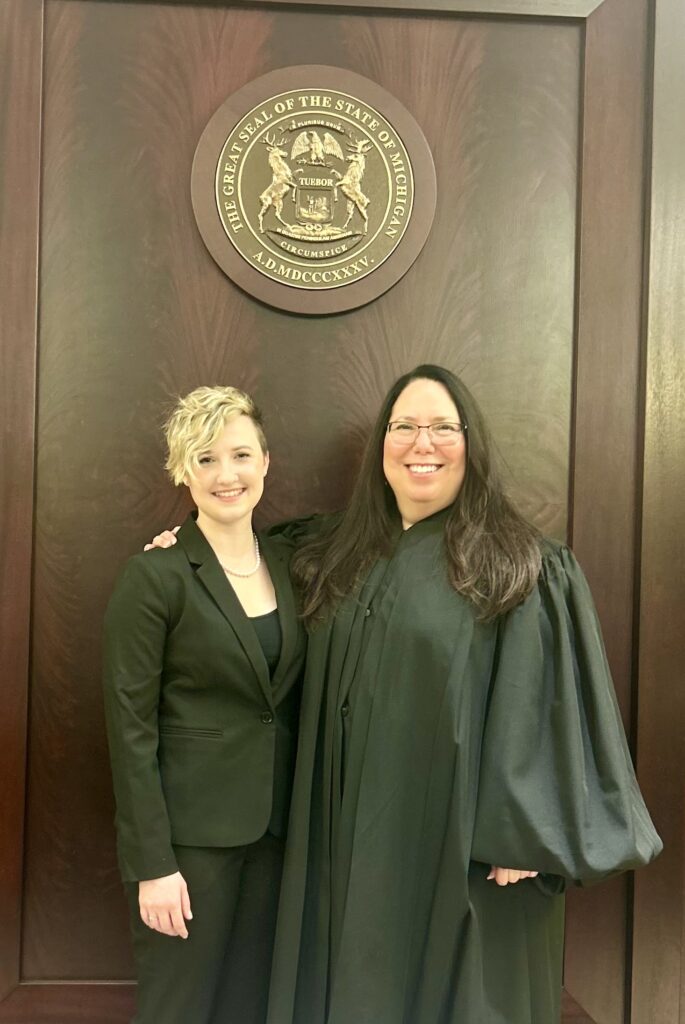 The LTBB agreed to partner with me. Through this partnership, I worked for the General Counsel, Jim Bransky, esq. in the legislative branch, and for the former Chief Judge of the Tribal court, Judge Allie Greenleaf Maldonado. The LTBB is a federally recognized Tribe of over 4,000 members with historically delineated reservation area in the northwestern part of Michigan’s lower peninsula. Judge Allie Greenleaf Maldonado is an enrolled member of the LTBB and a law graduate from the University of Michigan. After graduating, Judge Maldonado worked for the Department of Justice’s Honors Program. Eventually Judge Maldonado found herself working for her Tribe’s general counsel. She was later brought to the bench as the court’s Chief Judge. After years serving her Tribe, Judge Maldonado was appointed by Governor Whitmer to the Michigan Court of Appeals in 2023. She is the first Native person to serve on the Michigan Court of Appeals.
Through my work with Judge Maldonado, she introduced me to the Tribal State Federal Judicial Forum (Forum), a collective of Tribal, state, and federal judges dedicated to collaborating on shared issues in the state of Michigan. Judge Maldonado indicated that the Education Committee for the Forum wanted to compile a short list of Tribal court cases to share with first-year law professors and hopefully encourage them to teach more about Tribal laws. Realizing our shared interest in Indigenous based pedagogical development, Judge Maldonado, the Forum, and I committed to collaborating on this issue with the goal of developing a pedagogical resource for law schools.
As a non-Native person engaging with a Native community, ethical considerations were central and preceded all engagements. Indigenous research ethics like the work of Palyku scholar Ambelin Kwaymullina require non-Native researchers to ask ourselves the following questions: (a) Should you do this research at all?; (b) How does your positionality affect the research?; and (c) Are you following ethical research practices, particularly those grounded in community protocols? (a) My answer to the first question is yes because a Tribal leader, Judge Greenleaf Maldonado, specifically asked me to do the work. Had she not, my answer may have been different. (b) My positionality absolutely affects my research because I am a non Native settler who does not know how Native communities feel to be marginalized. I also do not fully understand Tribal laws from the Tribe’s cultural, epistemic, and embodied lenses. As I will articulate in the methodology and reflection sections, I addressed this second question through awareness, self-reflection, epistemic humility, and key Indigenous practices like visiting to try preventing my settler disposition from weakening the Indigenous, intersectional feminist goals of this project. For the third question, I followed ethical research practices I have learned from MSU’s Responsible and Ethical Conduct in Research workshops, Community Engagement workshops, and LTBB community protocols, upon which I expand in the subsequent section.
As Judge Maldonado and I worked together throughout the summer, she learned of my background with teaching and passion for pedagogy. Sharing in that passion, Judge Maldonado mentioned that she was part of the Forum’s Education Committee, and she and others on the committee were interested in advancing DEIB in legal education. The committee was aiming to compile a list of cases from the twelve federally-recognized Tribes in Michigan that corresponded with a first-year law curriculum, such that law school professors would integrate tribal law into their courses. Judge Maldonado asked if I would tackle the creation of that list.
I was delighted to work on the project! I was also unsure whether asking professors to include a couple cases in their courses would be received well or accomplish the Forum’s goals of addressing Native marginalization in legal education and the lack of awareness in the wider profession. I anticipated one of two responses from faculty: some might feel ill-equipped and reticent to add content to their syllabi that they themselves did not fully understand; others might include the cases–some even with enthusiasm–but the effect would be tokenizing by simply tacking on Tribal law without any groundwork or context provided. I shared these concerns with Judge Maldonado and asked if she would be open to the idea of a more robust handbook with context, resources, and pedagogical tips. She gave me the green light to run with it, and I am grateful that she trusted and empowered me to do so!
Two research questions guided my approach to the project:
- What basics in Tribal laws do legal practitioners need to know that both lays a foundation of professional development training and encourages students to pursue further education on Tribal law?
- How could we develop an educational resource to alleviate the pedagogical burden on faculty—who also tend to lack training in this area—while ensuring a proper DEIB approach that avoids tokenism and further marginalizing of Native peoples?
The first question required a Tribe-focused approach to education to mitigate the shortcomings of an opt-in approach. Even though the question contained an element of opting-in by encouraging students to pursue further education on Tribal law, the question prompted us to minimally ensure that all students are exposed to Tribal laws in a significant way during their first year so that the chances of students opting-in dramatically increases. The second question asked us to develop a strong pedagogical framework for introducing new materials in classes. When Judge Maldonado originally asked if I would tackle this project by just compiling a list of Tribal law cases to pitch to faculty, I suspected that most faculty would respond in one of two ways: either they would be resistant because they had no training or knowledge of Tribal laws and felt unequipped to teach them, or they would agree but not provide adequate context for students to understand the significance and intricacies of this body of laws. This meant that the resource had to provide context for students and faculty to engage with Tribal laws confidently and respectfully.
To tackle the first question of what legal practitioners need to know about Tribal laws, I first exercised active listening. This methodology was essential because I was not a legal practitioner at the time nor a Tribal member. After conversations with Judge Maldonado, we determined that pairing Tribal laws with key concepts in first-year law curricula would cover the main bases and integrate well with existing pedagogical frameworks in legal education. Thus, I compiled lists of Michigan’s five law schools first-year curricula. The first year of legal education is nearly uniform across the nation; for the schools that made optional a course that was mandatory elsewhere, I included that course. The results were the following courses: Civil Procedure; Constitutional Law; Contracts; Criminal Law; Property; Torts; and Writing, Research, and Advocacy.
Next, I began searching for and reading through dozens of Tribal court cases to find opinions that articulated Tribal laws in each of the domains. I searched in a small national Tribal law database for what I could find, and I went to every Tribe’s website to find more. A few Tribes do not make their opinions public, but for the majority who did, I read through nearly all of their cases.
There were several criteria I followed when selecting cases: first, I aimed for diverse representation from as many of the twelve Tribes as possible. Second, I aimed to find cases that relied on and developed a Tribe’s own laws. Since Tribes can use federal laws at their discretion, I wanted to select cases that centered Tribal laws as much as possible. Third, as with all law textbook editors, I strove to find cases that were digestible and accessible to less-experienced readers. This selection process worked for the standard courses, but for Research, Writing, and Advocacy, this course(s) focuses on skills over content. To find suitable content for this section of the handbook, I discussed with the judge the pitfalls into which many nonNative, untrained attorneys fell before her bench, and what skills she wished they had
prior to entering her court. She spoke of Tribal primacy, harmony over adversarial advocacy, and the emphasis on equity.
In addition to these conversations, I relied on what I witnessed in her court to inform this section. For example, my first bench memorandum that I wrote for Judge Maldonado was on the issue of due process. Due process is a familiar legal concept in court procedure, and there is an abundance of U.S. Supreme Court cases that clarify what legal test or analysis to perform to determine whether due process
has been upheld. For a case before the judge that summer 2022, the defendant’s attorney raised a due process violation claim and cited the U.S. Supreme Court’s test in Matthews v. Eldridge. This is the
correct test in federal contexts, but U.S. Supreme Court cases are not mandatory for Tribes to follow. What this attorney failed to do was start with the laws that are mandatory for Tribes: the Tribe’s own laws. The LTBB has a mandatory case that outlines a due process test, and this is what the attorney should have used to make her client’s case. Based on this experience and conversations with the judge, I selected a case that centered equity and the Tribe’s customary laws over federal ones.
I addressed the second question about anti-tokenism, effective DEIB pedagogy, and foundational development for instructors and students alike with all of the additional content that surrounded and accompanied the cases themselves. These included things like a Welcome Letter from the Forum, robust acknowledgements of land and contributors, strategies and insight regarding Trauma-Informed Pedagogy, additional resources for further reading about Tribal laws, and a “Meet the Tribes” section in which all twelve Tribes have a page with photos, emblems, contact information, and a narrative about the Tribe. The narratives are ones I pulled from their own websites to ensure that the Tribes were introducing themselves with their own words. The purpose of this section was to challenge the settler narrative of the “dying Indian.” By over-historicizing Indigenous peoples, there emerges an excuse to ignore and silence these communities. By including current photos and stories from the Tribes, I aimed to combat this narrative.
 Though I was in regular conversation with Judge Maldonado for her feedback, the main opportunity we curated for feedback on the project was at the Forum’s annual meeting in October 2023 at the Pokagon Band of Potawatomi. The two-day event modeled many of the engagement methods outlined in this narrative. For example, the first day included no talk of Forum business. Instead, we visited. Our hosts gave us a tour of their government facilities and told us about the intentional architectural design of each space. For example, the court room is circular with no points of elevation to encourage collaboration and non-hierarchical interactions. The ceiling reflects the heavens with the Seven Grandfather Teachings, and the wood paneling on the walls emulates a woven black ash basket. After the tour, we sat in their firekeeping room where Tribal members performed sacred fire and water ceremonies. There was gift-giving, songs, and storytelling. For lunch, we had a feast of traditional Anishinaabeg foods: strawberries, corn bread, the three sisters stew (corn, beans, and squash), and salad. The second day was when the Forum convened for business. During this time, I gave a short presentation of the project and invited feedback both from folks in the room and through a Google form for anyone joining virtually or who wanted to share feedback later. The project was met with enthusiasm, and the feedback was instrumental.
 Even though all twelve Tribes were represented at the Forum and consented to the development of the handbook, the foundational scholarship for this project pushed me to seek direct consent from each Tribe’s leadership about their inclusion in the book and the way they were represented in the narrative, photos, and cases. This process took place at the annual Forum meeting in 2024 and throughout the 2022-2024 calendar years.
There are not adequate words or space to describe how fulfilling this experience was to me personally and professionally. I think what I will cherish most is the relationship aspect. As I stated at the beginning of this portfolio, community engaged research starts with relationships and centers those relations through the process. It makes sense to me that at the end of his community engaged project, I would cherish most the relationships built along the way.
The book has been shared with Michigan’s law schools, libraries have requested and received copies, Michigan Indian Legal Services has it on their website, and other institutions and individuals continue to show interest and engagement with the resource. I am beyond honored to have been part of this project, and I am thrilled to see the positive impact that it is happening. Chi miigwech, Judge Maldonado, the Forum, Justice Cavanagh, Kristin Triplett, Wenona Singel, and everyone else who helped make this project possible.
